maite iribarren vázquez
Maite Iribarren Vázquez learns from the rules, codes, and guidelines that govern our built environment to produce absurdist sculptures that call attention to infrastructural subjectivity. In this conversation, we talk about performing as an engineer, defining system slop, and intervening in New York’s subway system.
Born in Miami, she now resides in Brooklyn, New York.
I hope you enjoy our conversation. It has been edited from a spoken interview and condensed for clarity.
Artwork photos courtesy of the artist; artist portrait courtesy of Kyra Bennington
Can we start with your background and why you decided to pursue a structural engineering degree at the same time as an art degree?
I made that decision very intentionally. To make the things that I wanted to make, I needed to understand how materials function and how to build things with them at every scale. Engineering has come to be even more important to my work on a conceptual level. I am interested in systems and conventions that shape and position our bodies. I’m often thinking about the built environment and how space is abstracted and shaped by legislation and building codes. These standards are shaped by political and market authorities that I witnessed in my education and professional experience as a structural engineer.
How does your previous experience working as an engineer show up in your work?
Engineers interpret building codes as if they were a priest interpreting the scriptures. That in turn determines the built environment—organizing bodies in space—which has so many social and cultural implications. The profession holds authority through its supposedly neutral and objective way of thinking of the world but it’s actually just building different versions of the world. Building codes and standards are written by people in a room making often times arbitrary decisions. They aren’t immune to their own humanity slipping into the work. The same is true for how laborers constrict architectures, infrastructures, and generic objects, despite attempts at being purely technical. I think that’s funny, absurd, scary, and beautiful all at the same time. That human slippage is what my work addresses.
When we first spoke, you talked about this as if you are performing the role of engineer. You are also interested in the idea of mastery which comes from taking your training all the way: pursuing an engineering degree; becoming trained as a classical goldsmith; possibly the same for glassblowing. Why this approach?
There’s at least two parts to that: the embedding of my own labor into the work and then appropriating the formal language of legitimacy and authority. I’m interested in mirroring the labor hidden in the built environment and in mass-produced objects. These things are considered generic and without human intervention, although human bodies and concerns are what inform when and how they are made. There’s always at least one component of my work that’s really labored over by me, but I try to make it look almost industrially produced in the same way that the built environment is so painstakingly constructed to make its labor invisible. It’s this performance for myself that nobody sees of embedding my hand into these things but not having it be this glorified artist gesture that requires technical mastery.
An example of that is perhaps the ones from your show at Foreign & Domestic: those copper sculptures which you did make from scratch, but look industrially made.
They could almost be found objects, but those forms would never be found.
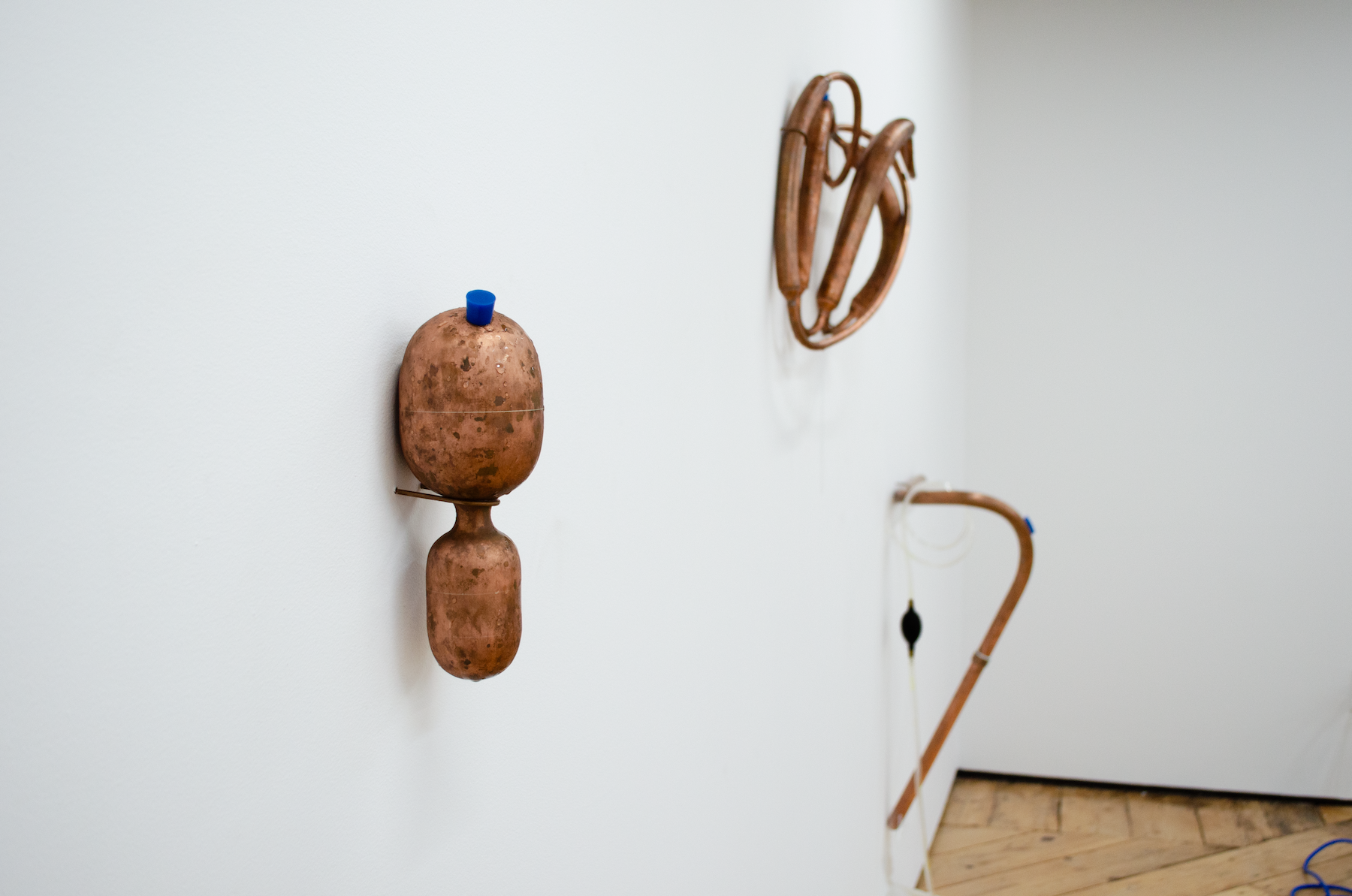
Cooling Unit 1, 2, and 3, all 2025, copper, silicone, ice, hand siphon pump, dimensions variable
And what about the idea of legitimacy?
The more conceptual side is this aura of authority or legitimacy. How is value assigned? How is truth assigned? What do we consider legitimate enough to not question?
Getting really informed about this stuff or going to engineering school and working this job that I hated, it felt important to be like, I know what I’m talking about. I see structural engineering as this thing that’s unquestioned. Most people aren’t engineers. You just take infrastructures and amenities for granted. It’s important to question the systems that inform these systems, which are very human. Even in engineering school, the first thing they tell you is that this is all based on fictitious models. But when stuff is thought of as so legitimate, so true, so objective, that’s how horrible things have been done in the world. Defining what “generic” looks like feels like a benign prototype for top-down system-making.
Once it becomes standardized, it becomes socialized.
I’ve been talking about this a lot where I feel like I’m trying to make system slop. I’m performing an objective algorithm that’s been machine-learning-style taught with this engineering background and my cultural contexts. Then I’m making a system slop by adhering to many things which might be true and good and within each logical framework and seeing how ridiculous I can get with them together.
How would you define system slop?
Well, I don’t think system slop is a thing. I hope not. By slop I mean a failed aggregate, more so than in an AI context. But in either context, there are so many systems superimposed and there’s so much literal computing power squeezed out of natural resources in order to combine so many ideas and standards to meet an impossible set of requirements. All of these logics are followed, but you follow the logics so far that they get real weird. A lot changes in translation. It collapses in on itself. I think that’s really great.
The logical pathways are there, but the outcome is the slop.
Yeah, even though it is mathematically true or legitimate. It adheres to these parameters that have been set. I guess that’s what I mean by system slop. But it’s not AI; it’s my brain, which is also interesting because I have a point of view. I’m a person with a life so that taints my algorithm.
But that’s exactly AI; it’s all affected by its creators.
That’s what I’m getting it. You really can’t strip humanity or the social out of anything. Nothing is that objective.
In the past month, you opened a solo show at the Al Held Foundation and presented your thesis project at Bard College. Could you introduce those two projects?
The Al Held show is for an archive fellowship that I got. I was really fascinated by the idea of an artist being able to move upstate, buy this compound, and build his massive home and studio and life there, which feels no longer really possible for most artists. I proposed to look at the foundation archive and see documents or correspondence between him and contractors or the city and construction material receipts as well as building codes that informed the construction of that space and make works that are hypothetical architectural features that would have worked within the material, logistic, and building code constraints that he had at the time.
Then I learned that the original development on that property was built by a man known as Ice King Bailey, who made his fortune selling ice: harvesting ice by chopping up the Hudson River when it froze over, storing it to sell in the summer, and then later manufacturing ice. It’s so poetic and strange. So that led me down this wormhole of thinking of hypothetical ice infrastructures or architectures for the ice that might have been in the space.
And can you describe the Bard thesis show?
The thesis show is in what used to be the place of worship for the Unification Church, also known as the Moonies cult. I’m interested in the way that building has recently been retrofitted to be an educational, cultural, and institutional space for Bard College. They’ve built all of these sprinkler pipes, makeshift, added in. I’m obsessed with that translation of space and culture. The work speaks to that specific context by seeing how far I can push this logic of the haphazard translation in both an infrastructural and bodily sense.
I think of the gesture of tying towels around leaking pipes to meet water flow requirements or improvised body modifications to meet beauty and gender standards. I intend for the absurdity of market incentives that shape these standards to be expressed in these imagined system fragments. They can almost be read as part of this retrofit. The bodies that built, inhabited, or designed the space are mutated back into it.
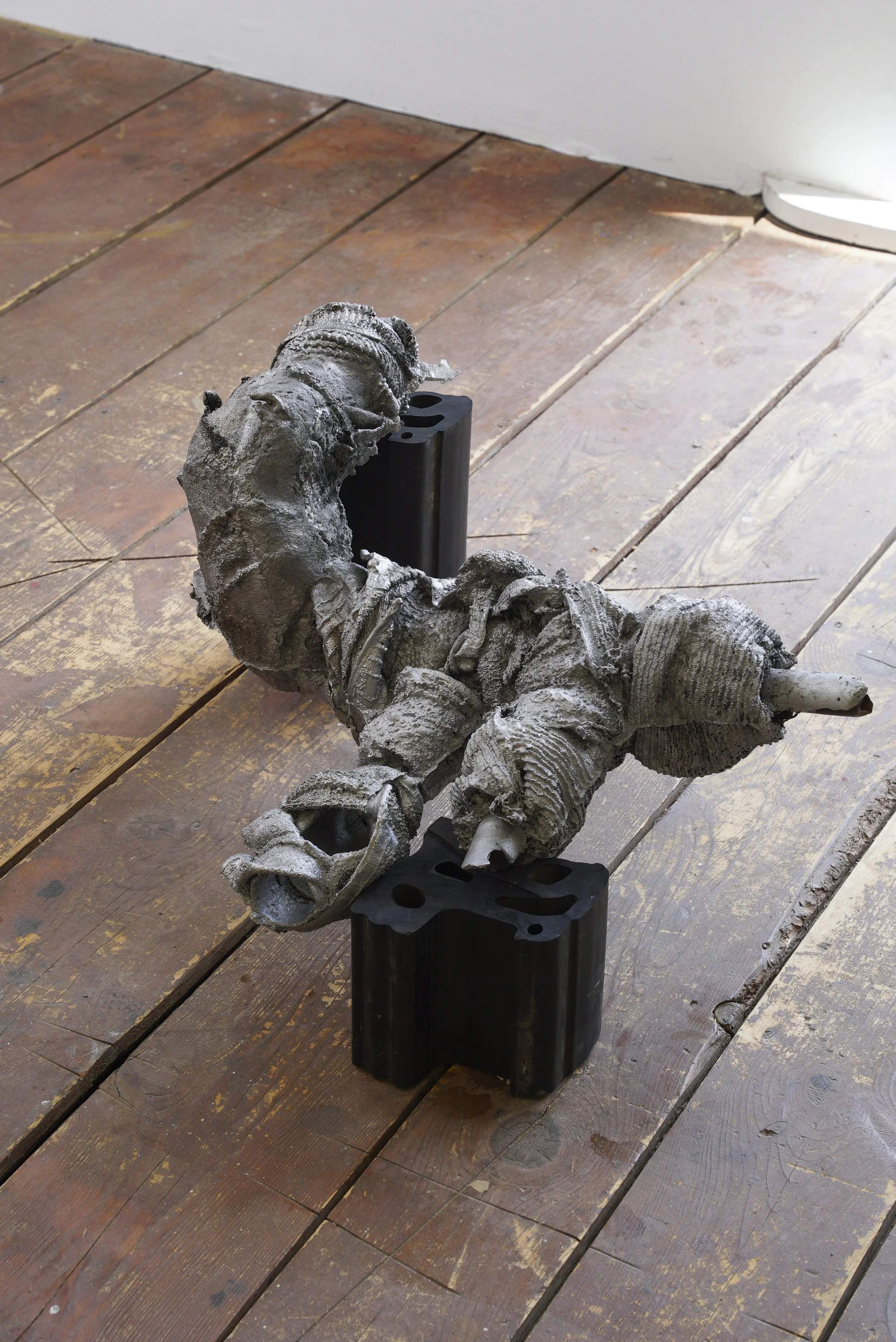
Insulated Arterial Cluster, 2026, cast aluminum, copper pipe and fittings, rubber, ceramic insulators, copper fasteners, and refrigerant milk, dimensions variable
Can you describe those interventions more?
Both shows have these pieces that are cast aluminum rags or towels, like the way you would precariously, really quickly, just wrap one around a leaking pipe. I like freezing that gesture and having it be this messy fix but then it gets frozen or crystallized into this cast thing that feels more industrial. The quick fix becomes the system itself.
Throughout the installation are pools of a liquid that I’m still developing with a material scientist to look like it melts a lot slower than water. It’s this milky white liquid that I keep talking about as refrigerant milk or industrial breast milk because it looks like what I’d imagine an infrastructure’s milk to look like.
It’s a supportive liquid.
Like data centers. It’s a ton of water but also refrigerant that keeps it all running.
And then you also have these pipe-like sculptures?
There are other, more fleshy pipe systems, cast silicone hoses with chiming steel baoding balls stuffed in them like clots. In general, I’m obsessed with pipes. They’re the first step in commodifying anything. A pipeline. It’s this ancient form. It’s also in bodies: blood vessels and plant stems. Pipes are these things that move freely between public and private space. Pipes are a good starting point for intervening in infrastructures because most places have them both inside and outside and they connect to larger systems.
The Al Held show is exciting for me because it’s all windows in an old barn so there’s an implication of it flowing between inside and outside.
Last time you referred to the cast aluminum towel sculptures as “adapters”? What does that term mean in your practice?
That idea is really important to my work right now. By adapters, I mean this interface between imagined forms or systems that I make and existing ones in a space. So they could clasp onto the sprinkler pipes or connect to the structure in a way that an adapter might connect, like an outlet or in plumbing those little T’s and elbows. This is my version of that. I can physically connect my material world to an existing material world.
Whenever I do a show, I always work really site-specifically, but it’s also important to me to make forms that feel like my own hypothetically standard forms. I used to make all of these public interventions, in the subway and in the street, and directly engage with existing things. And then I would make works in the studio and they’re these really fabricated things. It felt like two separate things. That’s where I’ve gotten to these adapters. They let me connect these two parts of my practice.
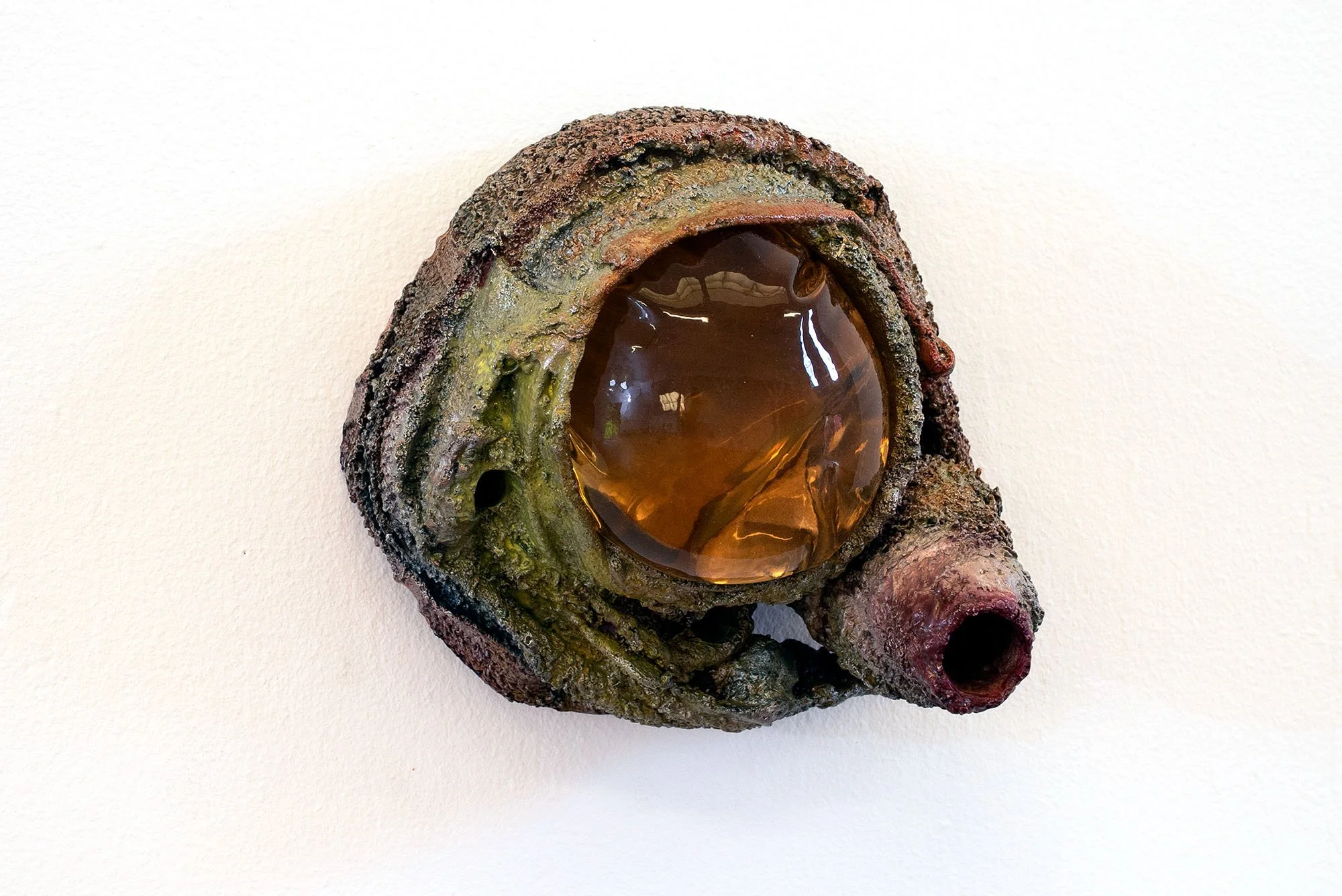
Valve, 2026, cast aluminum, oil paint, lipstick, silicone breast implant, emergency light, and hardware, dimensions variable
So the adapter is not a specific form then?
Yes and no, it changes depending on context.
Does it feel like a risk that you’re using overlooked objects or locating objects in overlooked places, in terms of having them be noticed? Has that been something that you’ve encountered?
That’s a question that I’ve had in my work. I do want it to pass just enough to not be read as just sculpture. I also don’t want it to read as found industrial forms that I put here. I am trying to do something more hypothetical. What hypothetically could be an industrial object or what hypothetically could be an architectural form? And thinking of how that might evolve in the future, maybe in a future past. Where it could go or how absurd it could get.
I’ve tried to avoid where it reads that I found some pipes and I did some little things to them. That’s when I feel that my work is not successful. The way that I’ve found to avoid that is by actually considering function and getting these things to work, even though it’s working towards a function that is totally absurd or pointless. I like that it’s futile.
We talked last time about how it is operating differently than a Minimalist or Post-Minimalist art object.
What I’m really trying to engage with is not industrial forms. I’m trying to engage with the logic that informs the logic that informs the industrial forms.
Which shows up through and by and because of the forms.
Because of Post-Minimalist sculpture, it’s really easy for work to engage with industrial forms. It’s hard to make work that says I’m considering that but I’m not really thinking about it. I’m more interested in something like the kinks of a commodity trader that get him to work with a specific manufacturer, leading the water lines in his city to be made in a specific way, which becomes the standard despite it being less efficient or way more toxic to installers. This is just an example but I’m thinking about the thing that’s thinking about the thing that’s thinking about the industrial or mass-produced forms.
Sometimes you are making objects from scratch and sometimes you are finding existing mass-produced objects to use. Can you talk about these two approaches and their differences for you?
With the things that I make, sometimes I have to just fully fabricate an object and sometimes it’s useful to start from a thing that I find. I don’t want it to look like an actually mass-produced object but it has to look like it maybe could be. It’s this really fine line. When I use existing objects—I hate the word “found,” it’s not even found, usually I’m stealing it from construction sites at night—whether they’re stolen or bought or found, I don’t want them to read as “found objects.” I want to find where humanity slipped into this standard form. So I transform it, manipulate it, to the point where it feels like a totally different thing.
When I’m fabricating something from scratch, it’s harder for it to look generic, less produced. Ultimately, I want both to look like something that could be industrially produced but are very uncanny and feel like some weird mutated evolution of these forms that maybe could happen.
Like the traffic barricades in your studio that you have clearly warped.
Making it feel made. I’m working against the original source of the thing. When it’s an existing thing that I’m modifying, like these big plastic traffic barricades, I need to overcompensate by making it feel fully formed by me. And when it’s something that I’m fully fabricating myself, then I need to overcompensate and make it feel industrially produced. But I hope that the end point is the same for both, that if I overcompensate in either direction, eventually they'll meet in the middle and feel like part of the same world.
With the rags and other work from the foundry, it is no longer just an industrial form or aesthetic but also an industrial process.
I’m obsessed with aluminum because that’s what I was working with as an engineer and it’s often what's used in building facades or specialty structures, which was my specialty in the field. When I was working at this scale where I wasn’t building the skeleton of an entire building, but I was engineering this thing to adapt onto another larger structure, aluminum was the go-to material.
I could even imagine eventually melting this back down where it is used to build new pipes. It’s back out on the street, then it's back here in your studio.
That feels important. After these shows, I’m excited now that I have access to the foundry. I want to start basically what I was doing before grad school—a lot more public interventions. Now I can actually make these adapters. I want to cast things that I put back into the city and see what happens. I can 3D scan stuff in the city and make a part that can connect back to it perfectly. If the Department of Transportation sees it, it will look a bit uncanny but they won’t really question it.
A seamless intervention that won’t call attention to itself because it won’t look handmade or DIY.
Because it’s appropriating the formal language of technical authority. It has this aura of legitimacy that makes it unquestioned. That’s really exciting to me. When I’ve done the city stuff before, sometimes it’ll disappear, get graffitied. It’s nice to see how people react.
You mentioned that an earlier project was tinting the color of the subway lights, right?
Yeah, the lighting in the last train of the L train. I made it warm. But it was clear yellow vinyl window stickers cut to size so they can just take them off, which makes it legally less risky for me to do. But this kind of work could also be bolted on in a way where they couldn’t take it off, like if I make custom bolts and a custom driver. Then it’s really infiltrating the logic.
And, if you can figure it out for one subway or station, you can figure it out for all of them because they are all standardized. There is mass potential. A gallery the size of the city.
It’s the perfect space. That’s where the work belongs. That’s the kind of public art I’m trying to make.
Part of this interview series is that I’m asking each artist to direct me to the next. So, who is an artist working today that you are intrigued by, and what is it about their practice you’re intrigued by?
JinJin Xu is an artist working with light and language, moving between installation, the moving image and performance. I am drawn to her work’s seamless interweaving of such diverse methods and media to create poetic spaces that choreograph emotion. In them, she witnesses histories of erasure and becoming, referencing testimonies of censorship and its relationship to kinship.
Published July 19, 2026